How to Build Strength and Exercise Tolerance Safely
If standing makes your heart race or traditional workouts feel almost impossible, the answer is not necessarily to avoid movement. It may be about changing where you start.

Exercise with POTS can look very different from traditional exercise
For many people with POTS, the key is finding the right type of movement, beginning in a position the body can tolerate and progressing gradually rather than simply trying to push through symptoms.
What is POTS?
Postural Orthostatic Tachycardia Syndrome is a form of autonomic dysfunction.
The autonomic nervous system helps regulate functions such as heart rate, blood pressure, circulation, digestion and temperature control.
With POTS, the body has difficulty adapting to an upright position.
When someone moves from lying down to standing, their heart rate may rise significantly as the cardiovascular system attempts to maintain adequate circulation.
Dizziness
Heart rate
Fatigue
Brain fog
Other symptoms can include headache, nausea and difficulty tolerating exercise.
POTS can affect people of different ages, although it is frequently diagnosed in adolescents and younger adults.
It can also occur alongside conditions including joint hypermobility, hypermobile Ehlers Danlos syndrome, ME/CFS and persistent pain.
Because everyone presents differently, exercise needs to be individualised.
Why is exercise difficult with POTS?
Standing places additional demands on the cardiovascular system.
Normally, your nervous system, blood vessels, heart and muscles work together to maintain blood flow when you move upright.
For someone with POTS, this response can be less effective.
That can make apparently simple activities such as standing for long periods, walking upstairs, exercising in the heat or completing a traditional gym session surprisingly difficult.
Lying / Reclined
Seated
Upright
This is why someone may feel relatively comfortable completing an exercise lying down but experience dizziness or a rapid increase in heart rate when performing the same movement standing.
What does deconditioning have to do with POTS?
Deconditioning does not mean someone developed POTS simply because they became unfit.
However, when symptoms make movement difficult, people may understandably become less active.
Over time, prolonged reductions in activity can contribute to cardiovascular and muscular deconditioning, which can make physical activity even harder.
The aim of rehabilitation is not to tell someone to “just exercise more”. It is to find movement the person can tolerate and gradually build capacity from there.
What exercise is recommended for POTS?
There is no single exercise program that is appropriate for every person with POTS.
Current evidence generally supports individualised exercise as part of a broader multidisciplinary management plan.
For people who find upright exercise difficult, rehabilitation may initially begin with exercise performed lying down, reclined or seated.
Lower limb strength
Trunk and core work
Resistance exercise
Recumbent cardiovascular exercise
As exercise tolerance improves, the program can gradually progress towards more upright activities.
The starting point, intensity, duration, recovery time and rate of progression all matter.
For someone whose symptoms increase significantly after exertion, particularly people experiencing post exertional malaise or coexisting ME/CFS, exercise needs to be approached even more cautiously. The goal is not to continually push through a symptom flare.
Can Clinical Pilates help with POTS?
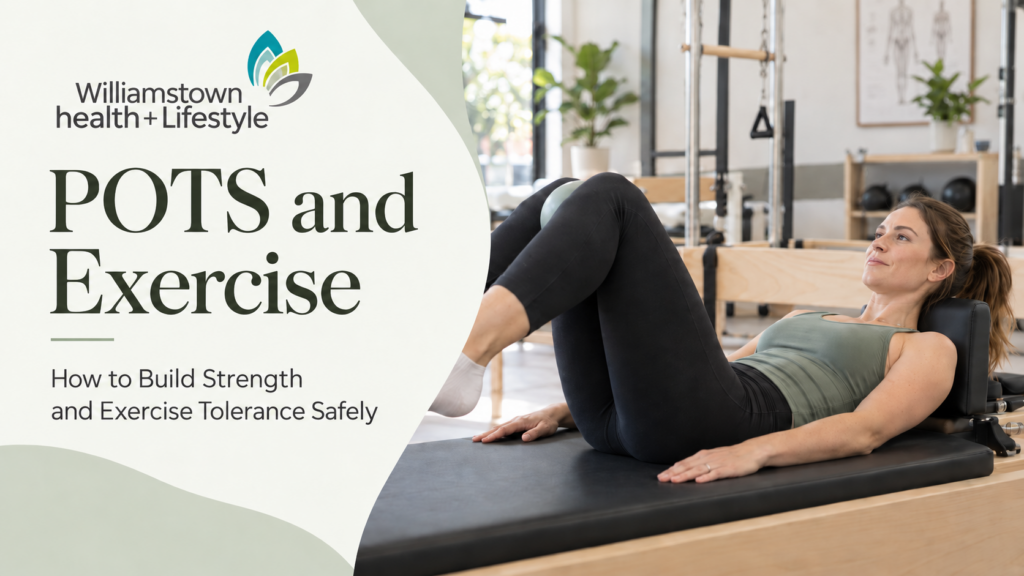
Clinical Pilates can be particularly useful because exercises can be easily modified around the person's current capacity.
Instead of expecting someone to immediately tolerate prolonged standing exercise, we can begin with supported movements on the reformer, table or floor.
We can change body position, resistance, exercise duration, repetitions and rest periods according to how someone responds.
For example, a person may begin with lying lower limb and trunk strengthening before progressing towards seated movements and eventually more upright exercises as their tolerance improves.
Clinical Pilates also allows us to work on strength, control and general movement capacity in people who may have other considerations such as joint hypermobility or persistent musculoskeletal pain.
The aim is not for Pilates to “treat” POTS itself. It is to provide an individualised way of building physical capacity while taking the person's symptoms and limitations into account.
Explore Clinical Pilates at Williamstown Health + LifestyleWhat role can osteopathy play?
People with POTS can also experience musculoskeletal pain, stiffness or movement limitations that make exercise more difficult.
Osteopathic management may be useful where these musculoskeletal factors are limiting someone's ability to move or participate in rehabilitation.
Treatment may involve assessing areas of pain or restriction alongside an individualised movement program.
The overall goal is to make movement more achievable, build confidence and help the person gradually increase what their body can tolerate.
POTS management is often multidisciplinary, so osteopathy and exercise should complement rather than replace appropriate medical assessment and management.
Learn more about Osteopathy at Williamstown Health + LifestyleIs exercise safe if I have POTS?
For many people with POTS, appropriately prescribed exercise can form an important part of management.
But more exercise is not automatically better.
Some people tolerate structured exercise relatively well. Others need to begin extremely gradually.
Symptoms, other health conditions, current activity levels and recovery following exercise should all influence how a program is prescribed.
This is why an individualised approach is so important.
How do you start exercising when you have POTS?
Sometimes the biggest hurdle is simply working out where to begin.
You may not need to start with running, a gym workout or even standing exercise.
Your starting point might be ten minutes of carefully selected exercises lying down.
Find what you currently tolerate
Watch your response
Progress gradually
Progress does not always mean working harder. Sometimes progress means completing the same activity with fewer symptoms, recovering more quickly or tolerating a more upright position.
When should POTS be medically assessed?
Symptoms such as recurrent dizziness, fainting, unexplained tachycardia or a significant increase in heart rate when standing should be appropriately medically assessed.
POTS is a medical diagnosis and other causes of similar symptoms need to be considered.
Assessment commonly involves measuring heart rate and blood pressure while lying and standing, alongside consideration of symptoms and other potential causes.
Once a diagnosis has been made, a multidisciplinary approach can help address the different components of POTS management.
Living with POTS does not mean giving up movement
Exercise with POTS can look very different from traditional exercise.
For some people, the first step is simply finding a position where movement feels manageable.
From there, appropriately modified exercise can help build strength, cardiovascular capacity, movement tolerance and confidence.
The important part is starting at your level rather than someone else's.
Not sure where to start with exercise?
Our Clinical Pilates sessions and individual rehabilitation programs can be modified around your current capacity, symptoms and movement goals.
If POTS, dizziness, fatigue or exercise intolerance are making it difficult to know how to exercise, our team can help you work out an appropriate place to start.
03 9397 8877